How could our ancestors be so uneducated, yet so wise? Strange, right?
When people dance the “Teshkoto”, their bodies release endorphins that are 80 times stronger than morphine. The “Berovka” oro* is said to help with colon health. “Pajdushko” lifts the energy of love. “Drachevka” balances the lymphatic system and supports the heart.
These are things passed down through tradition. We can choose to believe them or not. Maybe they aren’t scientifically proven and maybe that’s actually a good thing. Today, we can “prove” whatever we want, depending on what suits us. So perhaps it’s better to leave these in the realm of tradition. For those who believe, it becomes healing. For those who don’t, it’s just superstition. It’s a personal choice.
Still, let’s try to explore how this might actually work.
All of creation moves in harmony. Even saying that is a bit simplified, because we often think harmony means stillness. And stillness gets mistaken for peace. But the real peace doesn’t mean no movement because lack of movement is actually closer to regression and death than to growth and life.
So, creation is always moving, always trying to find balance even as it grows and evolves. That constant shift is part of the process.
At the same time, every part of creation is essential. And creation protects each part using everything it has. On a deeper level, everything is energy, or more accurately, information (though that’s not the focus here). So when a person, who is part of creation, becomes endangered, the whole system works together, using all its resources to help.
We already know the basic structure of a human being: a physical body, plus an energetic body. These two are one complete system, connected through energy centers, meridians, and specific points in the body. Through these, energy flows constantly, though its intensity changes.
When we get sick, it’s often because something in that energy system falls out of balance. During an epidemic, the imbalance is even greater. In both cases, what activates is the “immune system” of creation. This is part of the collective consciousness. It responds instantly, sending a specific combination of energetic “qualities” to act as a “remedy” for the affected part. In this case, a person or a whole community.
The goal? To restore balance and harmony.
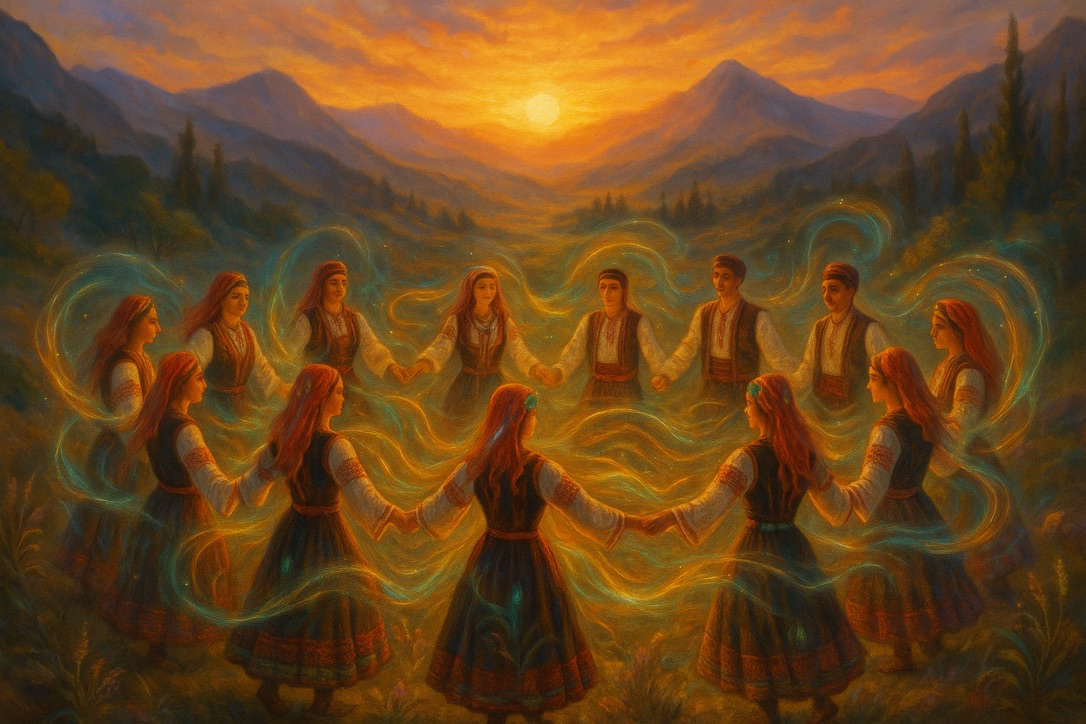
These energetic qualities include rhythm, movement, and geometric structure. And guess what? These are exactly the qualities that make up traditional folk ‘oro’ dances.
That’s why, yes, traditional oro dances have healing power.
Because they combine exactly the kind of energy that brings harmony and balance, both for individuals and for communities.
These dances may have been “requested” through prayer, intention, or emotion, either for someone who was ill or for the collective during a crisis. And they were “received” as a gift from creation. Their main purpose was, and still is, to restore active harmony between people and the universe. And harmony means health, happiness, and well-being.
But how were these dances channeled?
Traditional folk ‘oro’ dances were passed down from our ancestors who lived in simpler times.
Their minds weren’t racing with thousands of thoughts at once. Often, the mind was in what we’d now call a “mono” mode. You’d spend the whole day plowing a field (a single activity), or herding animals (again, one focused task).
When the mind is doing just one thing and if that activity exhausts the body enough that you no longer “feel” it (which is similar to deep meditation), you enter a different state of being. You become purely present, naturally connected to the universe, to the collective energy. Many people have experienced this today: doing long, repetitive activities that tire them out. Your Sensei, for example, has had many spontaneous downloads during long-distance running (a repetitive, exhausting activity).
That’s how, among other ways, our ancestors received these dances – combinations of rhythm, movement, and energy patterns all designed to bring harmony to specific parts of the human energetic system.
In that way, humans were given a powerful tool: a way to enter deep alignment with the universe. Just think of dancers performing an oro who’ve mastered their technique – their faces light up in pure joy when they all fall into rhythm together.
No, it’s not outdated. Not at all.
Keep our traditional oro dances alive.
Let this ancient wisdom never be forgotten.
With deep respect,
Sensei
[*Oro is a traditional circle dance rooted in the cultural heritage of the Balkan region. The word ‘oro’ means “dance” and is typically performed in a group, where dancers hold hands, shoulders, or belts and move in a synchronized pattern, often forming a circle or a line. Each oro has its own rhythm, steps, and symbolic meaning, passed down through generations. These dances are performed at weddings, festivals, and important cultural gatherings, and are often accompanied by traditional music played on instruments like the zurla, tapan, and kaval.]